Showing posts with label Horticulture Internship. Show all posts

Friday, July 28, 2017

Cacophony

Life—the thrust of living—seems raw and irrepressible on a day like that. Every niche, no matter how small, is fully occupied, no-vacancy signs visible everywhere. At dawn I walk through one spider trap after another, trailing silk by the time I get to the barn. Any object I move, I discover a colony of creatures behind it or under it or inside it. This is a farm of overlapping settlements and empires, and I plod through like Godzilla, undoing the work of the ant and earwig nations just by moving a five gallon bucket or a fence rail. (209) More Scenes from the Rural Life by Verlyn Klinkenborg

I try to garden for a short time each morning before the heat of summer builds. Gardening is a meditative act for me; it gives me the mental space to think. I step out of the house into the silence of our new property, no earbuds, no discussion. I am alone, lost in thought with an agenda at hand that usually includes watering and weeding.


However, now that the neighbors have spotted not one but two black bears in the neighborhood, I find my senses heightened lest I run into the trespassers. My increased awareness has brought to my attention that I really don't step into solitude and quiet when I step out into the green. Rather, from the time the first bird announces dawn's arrival to the cacophony of insects that fill the darkness at day's end like the chorus in a Wagnerian opera, nature is engaged in a drama of living and dying all around me.


I need only engage my senses to begin to see it. My recent observations include:

  • The bumblebee hid under the leaves of the zinnias to stay dry from the watering can's heavy downpour.
  • The sounds of woodpeckers hard at work echoed through the woods.
  • Butterflies of all shapes, sizes and colors were feasting on the unidentified flowering tree beside the house. (Note to self: figure out what kind of tree blooms in the heat of July!)
  • The crows were gathering and cawing to ward off the small hawk that landed near the circle drive.
  • I am delighted to still recognize the song of the cardinal, the call of the blue jay. 
  • The toad found relief from the heat under the trim by the garage, blending in perfectly with the red Virginia brick.
  • The yellow jackets swarmed around a large nest in the ground next near the forsythias behind the house, threatening the lawn guys and prompting a call to pest control.
  • The salamanders with black body and indigo-violet tales sit in wait for crickets and beetles and roaches, baking in the sun on the brick walk.
  • The red ants organized an offensive at the very thought of an attack; unfortunately, they settled at the foot of the front entrance.
  • The gang of deer ravage the neighborhood, particularly the pack of six bucks that devour my hydrangeas without a second glance. Once the rut begins, they'll be in competition but now they bow to peer pressure under the gaze of the buck with the rack that is inordinately large for July.
  • Twin fawns emerge from the wood's edge, seemingly abandoned as mother has yet to be spotted.
  • The housing market remains hot for wasps, causing a building boom; the hornets simply focus on an addition to their dwelling to accommodate newcomers to the nest.
  • The hummingbirds remind me to focus on adding (deer-resistant) flowers to the beds next year.
  • The bugs continue to amaze me in size and variety, including dragonflies with black and white striped wings and beetles of emerald green. However, the spiders are a topic I would rather not discuss. 
  • The petitions of the praying mantis rose up from the flower pot on the back deck.


Amazing what one small plot of land yields. Peace and joy remain amidst the cacophony. 


Monday, July 3, 2017

Gardening

And that was—is—the miraculous power of gardening: it invites plans and ambitions, creativity, expectation. Next year I will try celeriac. And that new pale blue sweet pea. Would Iris stylosa to just here? And what about sweet woodruff in that shady corner? Gardening defies time; you labor today in the interests of tomorrow; you think in seasons to come, cutting down the border this autumn but with next spring in your mind’s eye.  (33) Dancing Fish and Ammonites by Penelope Lively

After two years of transition, my family and I are finally settled in Charlottesville, a brick colonial so appropriate for Jefferson's hometown and its love affair with red bricks. No surprise as the soil is very fertile and tinted red as well. We live less than 3 miles to the university, shopping, and the high school and sit on a nearly 5 acre nook with woods and creek. Although it took some time to find this gem, I am so grateful for our good fortune and patience.

July is bringing me time to breath in the quiet, to think about the future, and to garden. I spend an hour here and there gardening each day now. I begin a bit late this growing season as the summer heat is already in full force, yet my efforts will bear fruition as I get to know the property, begin to construct a plan for the future, and plant selectively. I forgot that few things brings me as much joy as working the soil.

Gardening immerses you in nature no matter how big or small your efforts. And, nature abounds at "Nara," the name we have given our new home. Deer roam the area here in small herds and hearken back to Nara Park in Japan and its deer, a national treasure considered messengers of the gods in Shinto. I love to think the same of our deer, approaching them with reverence rather than as an adversary as I am prone to do.

Toads, turtles, squirrels, woodpeckers, raccoons, and numerous songbirds frequent our neighborhood. Last week, a black bear's visit caused quite a commotion and places me on high alert when I am out gardening. The visitor took down a neighbor's bird seed feeder and enjoyed a late night snack. I was emboldened to not feed the wildlife around me anymore -- no feeder for us at Nara -- rather to plant in ways that provides habitat and supports all the living things around me.

I have begun weeding and trimming. I planted a small bed of French marigold seeds I saved from Ithaca right next to another small bed of lavender. I love the intense color of purple when lavender is grouped together. And, their smell brings me back to one of my earliest memories, my only memory of my mother's mother. I must have been around three years old, and we shopped together at a neighborhood, corner store in Milwaukee's long gone German community. I chose a small, green, rounded bottom glass bottle of perfume with a green, round plastic top. I remember carrying this rare and precious gift with great care. The scent must have been heavily lavender as I always return to the long lost bottle in my mind to this day when I breathe in lavender.


My new neighbor shared that the deer overlook the pumpkins and cucumbers in her garden. So, I planted a few pumpkin pie seeds in the midst of the milkweed seeds I had scattered in hopes that one day I might be able to attract and feed some monarch butterflies. Nothing surprised me more than to see the pumpkin seedlings emerge from the soil in less than a week. I am not sure why, but the life source of a seed still amazes me.

I remember planting seeds (likely pumpkins or beans or peas) in a paper cup in Kindergarten. I was attentive and nurturing and engaged even then. Maybe, my love of gardening returns me to the joys of childhood. I witnessed such joy the other evening at my daughter's swim meet when a small girl walked round and round in astonishment. "Look! It's a firefly!" Pause. "Look! It's a firefly!" Her voice was sweet and soft and breathy. She was beholding with great wonder. May we all do the same.


Tuesday, January 13, 2015

Feeder

I am down to one feeder in our back yard. It is large, "squirrel-proof" and filled with nyjer and black sunflower seeds which interests the songbirds while keeping the house sparrows at bay.
I recently watched Margaret Roach of A Way to Garden on Growing a Greener World. The podcast focused on gardening for birds.
Margaret really got me thinking differently about how I landscape and plant on my little acre at NOLD, keeping the health and needs of wildlife in mind.
The fundamental concept is simple: Why place feeders out when your landscape may feed and care for birds all year round, if you plan appropriately and choose foliage carefully?
In large part, this philosophy rests on learning from nature and returning our landscape to a more balanced natural setting.
I will proceed from this starting point when I plan for the garden in the spring -- small steps in the right direction with the long term in mind.
On my walk last week as we saw a brief winter thaw, I could see food for wildlife all around me along the roadside.
The neighborhood is littered with plants and bushes that provide berries and seeds for the taking throughout the winter.
Some were planted purposely; some were not. Some were cultivated plantings; others were "weeds" spread naturally -- one must contain their chokehold, but they provide food for wildlife nonetheless.
Over the next few months, I will be contemplating steps I can take to fill nature's feeder more than the actual bird feeder I set up under the cedar grove in the back yard. I have much to learn, but I can't wait to get started.

Saturday, December 13, 2014

Snag

I have run into plenty of snags lately like the new rye bread recipe that I had planned to gift but wasn't fit for human consumption after my first attempt. Or, the unrealistic number of projects I planned to complete in December for the holidays or as a foundation for resolutions in the coming year. Or, an extended snowfall that never reached the volume to cancel school but certainly curtailed plans and slowed carpool travel for this mom.
Still, the snowfall has been beautiful and lasting, because the wind hasn't picked up to knock it from the branches and the temperatures haven't spiked to melt it away. This is winter at its finest and just in time for decorating for the holidays. Here, I inadvertently encountered a snag of another sort and learned something new in the process, too.
The established English Yews on our property have seen better days. The deer nibble incessantly on them in the winter such that the bush closest to the front door had so little greenery left, it died last summer. Instead of allowing my husband to yank it from the ground immediately, I decided to string it with white lights linked by timer with the lantern nearby as a festive touch at nightfall, some ambiance of sorts in my book.
Then, I read about snags, or wildlife trees, on A Way to Garden, a horticulture blog by Margaret Roach that I follow and highly recommend. Margaret suggests cultivating dead and dying trees and bushes as habitat for living things. Remove what is necessary for safety and leave the rest as biomass to balance the ecosystem in your garden. What do you know? The English Yew Snag is not only beautifully lit but also an essential element to the health of our land. I can live with a snag like that.
Finally, I began my cookie baking this week which really brought the holiday spirit into the house along with the snow and some carols. For cookie aficionados throughout the year, I have to recommend a new book, European Cookies for Every Occasion by Krisztina Maksai. The directions are thorough and the recipes increase in difficulty with each successive chapter so that you can bake cookies that not only appeal to your palate but also insure success at your skill level in the kitchen. I am sure someone would reward you deliciously, if you gifted it this holiday season. Just an idea to ponder....

Wednesday, September 17, 2014

Brambles

I have been stuck wrestling with the brambles. If you have ever bought a neglected, overgrown property, you will know exactly what I am talking about here. I am making progress, but I see life differently right now. In fact, I see life filtered through a pile of brush, cluttered with debris. All the while, I have a goal in mind: simplification outside and inside of NOLD.

I am hoping to strike a balance on our property: I want it to look natural but controlled. Organized chaos. This may sound like an oxymoron, and I can see my father roll his eyes, but I do believe that nature does need to be maintained or the weeds will overtake the landscape and unwanted interlopers will suffocate the diversity of vegetation one might ideally cultivate.

In fact, you wouldn't know it, but a decade ago, an avid gardener owned NOLD. Neighbors still remember the beautiful state of the property due to his keen eye and tireless effort. After three years of sweat equity, things are slowly beginning to take shape. Slowly. I am working in stages and have had help along the way, too.

First, we hired a tree service to remove the large dead and decaying trees as well as trim back the large trees near the house that clog the gutters and may damage the slate roof in severe weather. I always learn something when they come. They advised me to save the viburnum bushes -- trim back the dead growth but do not remove. Sure enough, they came back as good as new. I was also advised to feed the precious oak out front iron. The light green color of its leaves are a symptom of iron deficiency. So, I comply.

In May the last two years, my parents came to weed, thin, and trim up the landscape behind the house. We have been working carefully to try to remove weeds and invasive species while uncovering and saving perennials hidden beneath the overgrowth. All the travel over the summer set me back in this area, but I do see an end in sight next year. As motivation, I am reminded that we have already brought many trees, bushes, and plants back to health like the mountain laurel that bloomed in splendor earlier in the summer:
Now, I am working my way around the house, tackling the brambles around the remaining perimeter of the property. I hope to see the brush pile at the end of the drive continue to grow, awaiting pick up at the end of the month. I will work until the cold sends me running, until November I hope, for the work suits me -- the exercise, the sun, the fresh air, the tangible progress foot-by-foot. I hope to defeat the brambles before the cold defeats me.

In the meantime, as I work to order my very small, immediate world, the following poem emerged:

World Order

Memorize the alphabet
Learn the days of the week
Organize books with the Dewey Decimal System
Classify the periodic table of the elements
Compile references
Calculate distance, metric system preferred
Start the stop watch
Set the timer
Watch the clock
Establish a calendar
Weigh in and weigh out
Theorize, collect date, and analyze to conclusion
Discover laws and set laws
Establish atomic order, birth order, and rules of order
Arrange color in a wheel
Scale music
Measure beats and temperature, pulse and pressure
Mechanize and computerize, revolutionize and modernize
Accumulate milestones and credentials, victories and accomplishments
Collect your thoughts, voice an opinion, and send it out into the universe
Work to turn potential energy into kinetic energy
Know, despite the chaos, nothing is ever lost

Thursday, July 31, 2014

Rhubarb

Rhubarb
by Sheila Packa


Celebrate bitter things
after long winter
rhubarbs' red green stalks
and partial sun
shared with cutworm and fly
and ants that come—
no house can resist their arrival.
Life's too much or not enough—
savor the undernote of butter.
Smile in dandelions' faces
after the rabbits take other blossoms.
Taste from the plate I've heaped
tart rhubarb
ripe strawberries and sugar.
The rhubarb plant in the corner of my parents' garden has been there for as long as I can remember. It keeps producing, year after year, with little care to such an extent that it provides plenty of stalks for them as well as friends and family. The only concern that persists is that its wide leaves spread broadly in circumference and crowd the other vegetables.
I am convinced that rhubarb may be the easiest to plant with certainty of a harvest for the novice gardener. Soil quality is not of importance, since you can regularly amend it with compost and mulch. Rhubarb needs plenty of sun and water and a year to establish its roots. By the second year, you will reap abundant rewards. Since the leaves are poisonous and soon discarded, they elude the deer and may endure a bit of damage from the weather or pests without worry.
I planted two rhubarb plants last year that are now well established and provide a steady supply of stalks. Rhubarb freezes well when trimmed and chopped, and I have already frozen at least a half dozen two-cup portions for the winter. Still, the production of the pair persists. As such, I have been searching for exceptional rhubarb recipes which help to elevate its common status closer to its true potential as a prized ingredient. Here are two delicious dessert combinations that compliment rhubarb with ginger and lemon both from Rustic Fruit Desserts by Cory Schreiber and Julie Richardson.

Lemon Buttermilk Rhubarb Bundt Cake
Cake:
2 1/2 cups plus 2 tablespoons all purpose, unbleached flour
2 teaspoons baking powder
1 teaspoon fine sea salt
1 cup unsalted butter
1 3/4 cups granulated sugar
Zest of 1 lemon
3 eggs
1/2 teaspoon lemon oil
3/4 cup buttermilk
1 pound rhubarb, trimmed and very thinly sliced (3 cups prepped)

Lemon Glaze:
2 cups confectioners' sugar, more as needed
Juice of 1 lemon
1 tablespoon unsalted butter, softened
  1. Preheat oven to 350. Butter a 10-cup bundt pan.
  2. To make the cake, sift the 2 1/2 cups flour, the baking powder and salt together in a bowl. Using a handheld mixer with beaters or a stand mixer with the paddle attachment, cream the butter, sugar and lemon zest together on medium-high speed for 3 to 5 minutes, until light and fluffy. Add the eggs one at a time, scraping down the sides of the bowl after each addition, then stir in the lemon oil. Stir in the flour mixture in three additions alternating with the buttermilk in two additions, beginning and ending with the flour mixture and scraping down the sides of the bowl occasionally. The batter will be very thick.
  3. Toss the rhubarb with the 2 tablespoons of flour and fold half into the batter. Pour the batter into the prepared pan and sprinkle the remaining rhubarb on top.
  4. Bake for 30 minutes, then rotate the pan and cook for an additional 30 minutes, or until the center springs back when lightly touched. Cool the cake in its pan on the wire rack for 30 minutes before inverting and removing the pan.
  5. To make the lemon glaze, whisk the confectioners' sugar, lemon juice and butter together. The mixture should be thick. If it’s not, whisk in another tablespoon or two of the sugar. Spread the glaze over the cake as soon as you remove it from the pan.
Yield: 10 to 12 servings

Rhubarb Buckle with Ginger Crumb

Topping:
1/3 cup granulated sugar
1/4 cup all-purpose flour
1/4 cup finely chopped candied ginger
2 tablespoons unsalted butter, melted

Cake:
1 3/4 cup all-purpose flour
1 teaspoon baking powder
1 teaspoon dried ginger
1/2 teaspoon baking soda
1/2 teaspoon fine sea salt
3/4 cups unsalted butter, at room temperature
1 cup granulated sugar
2 eggs
3/4 cups buttermilk, at room temperature
1 pound rhubarb, trimmed and thinly sliced 

1.    Heat oven to 350 degrees. Butter a 9-inch round baking pan.
2.    Make the topping: Mix sugar, flour, and candied ginger together in a bowl, then stir in melted butter. Put the topping in the freezer while you mix up the cake.
3.    Make the cake: whisk flour, baking powder, ginger, baking soda, and salt in a bowl. Using a handheld mixer with beaters, or a stand mixer with paddle attachment, cream the butter and sugar together on medium-high speed until light and fluffy, about 3 to 5 minutes. Add the eggs, one at a time, scraping down sides of bowl after each addition. Stir in the flour mixture in three additions, alternating with buttermilk in two additions, beginning and ending with dry ingredients, and scraping down the sides of the bowl occasionally. Gently fold in rhubarb.
4.    Spread the batter into the prepared pan, then sprinkle the crumb topping over the cake. Bake for 45 to 50 minutes, or until lightly golden, and firm on top.
5.    Store wrapped in plastic, at room temperature, for 2 to 3 days.
Yield: 8 to 10 servings

Saturday, June 14, 2014

Volunteers

Iowa farmers used to call a stalk of corn growing in a soybean field a "volunteer." I've always loved the personification lurking in that use of the word, as though a cornstalk among the soybeans were like a zealous schoolgirl sitting in the first row of desks, arm thrust in the air after every question....
Walking back to the barn, I crossed a slope filled with maidenhair ferns, not a bit different from the cultivated one we put beside the hostas last spring. The hillside, once a field, had filled with saplings. A couple of years ago, you might have mowed them down with a bush hog. No longer. They've passed the point where they could accurately be called volunteers. Now, they've made the place their own. (81-83) Verlyn Klinkenborg, The Rural Life
The grounds of NOLD are filled with volunteers, the unexpected shoots and saplings of vegetation not cultivated but the result of seeds carried along by nature and planted with serendipity to surprise the gardener. The most astonishing volunteer I discovered so far is the Dawn Redwood or Metasequioa, one of three species of deciduous conifers known as redwoods. I am thrilled to no end after my recent visit to Muir Woods.
The Dawn Redwood had left me clues, innumerable small pine cones like the one above strewn across our back drive. Unusual in size, hardness, and shape, I had never seen pine cones such as these until I ran across a piece on them in Margaret Roach's blog, A Way to Garden.
Sure enough, just over the stream on our neighbor's property stands a majestic Dawn Redwood with its characteristic red colored bark, bundled trunk, and long, lean lines. I have a difficult time photographing it, but it is the tallest tree around in a community of large, old growth.
The species was thought to be extinct until rediscovered in China in the 1940s. The Arnold Arboretum of Harvard University collected and distributed seeds in 1948 for research and study, reintroducing this "living fossil" to North America. I have yet to find out how this Dawn Redwood ended up next door.
In the meantime, I discovered three volunteer Dawn Redwood saplings thriving in a flower bed nearby. I had nearly pulled and composted the trees, because they appeared dead after our bitterly cold winter, having shed their browned needles. I didn't realize that conifers could be deciduous.
Come autumn, two Dawn Redwoods will be transplanted in the front of the property with ample space conducive to their mature size, and one will be sent to the property of friends nearby. Clearly, they chose NOLD and have made it their own home. I am more than happy to comply.
Three Dawn Redwood volunteers discovered in the underbrush. The finding that ancient giants may live in our midst without detection, without really being seen, seems mysterious and magical. All I can say for certain is this: I have been given an exceptional gift, an enduring reminder to always embrace serendipity in life as in the garden, plain and simple.

Saturday, June 7, 2014

White

I am trying to think through carefully the footprint I leave in the gardens and lawn on my property, using organic methods and introducing primarily perennial plants that are local, deer resistant, and drought tolerant.

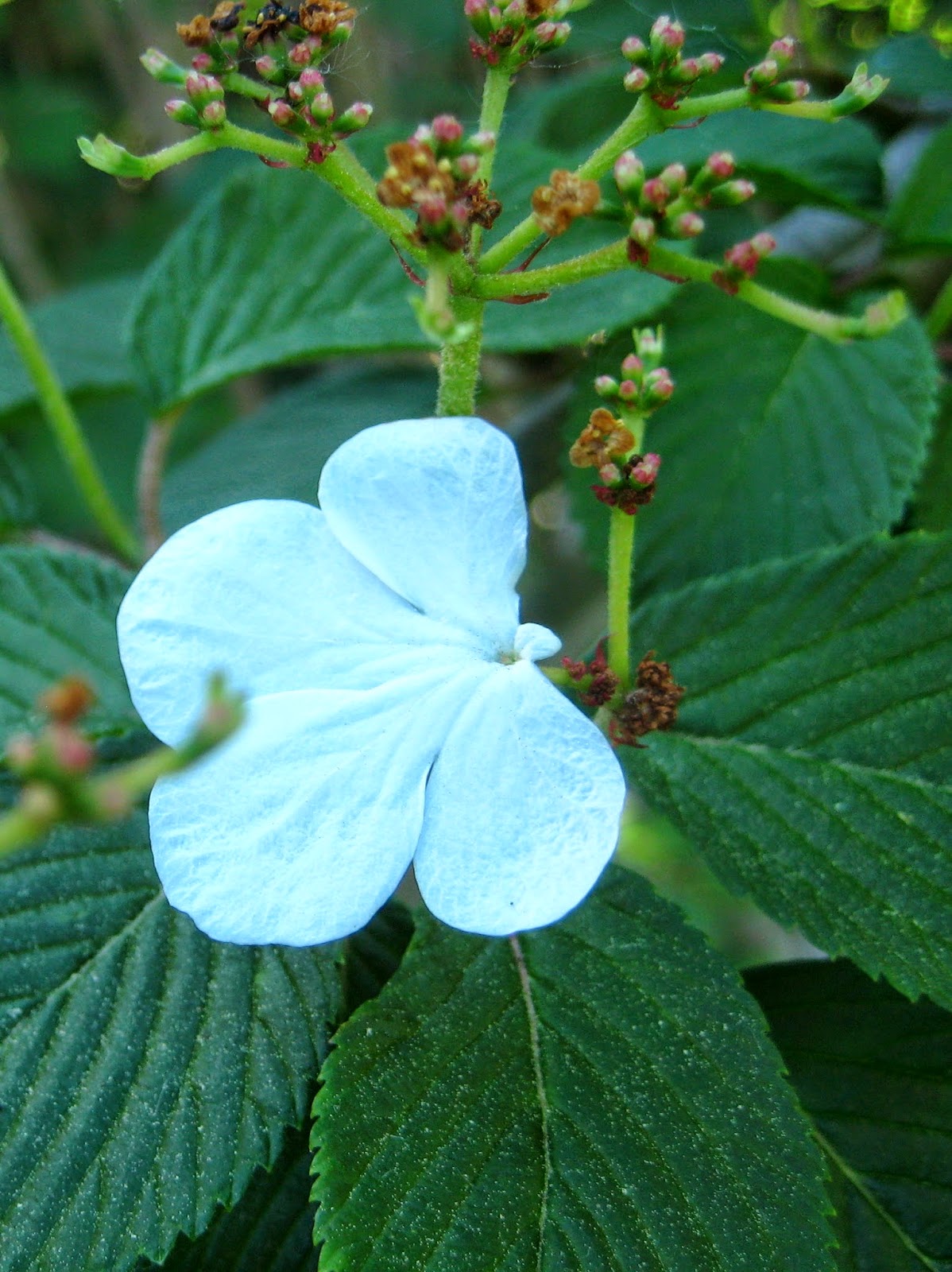
In this vein, I continue to discover and assess plantings beneath the overgrowth of NOLD, noticing a handful of different white blooms in our midst.
Bleeding Heart

Their shapes are varied.

Their shades of white cover the spectrum as well.
Trillium

Some I have identified.
Azalea

Some I still need to name.
Lily of the Valley

Nonetheless, the beauty of the white blooms needs no label.
Asian Pear

So, I work to restore many plants and bushes back to health.
Vibernum

And, I weed vigorously to control the invasive plants that threaten to smother out desirable vegetation.
Garlic Mustard -- Eradicate or, at a Minimum, Control

At the same time, I am embracing weeds that may deserve a more elevated place in the garden.
Dandelion -- Embrace Along with Clover 
Essential Sustenance to Monarchs Before Milkweed Blooms

I try to do an hour of work in the garden each day, weeding by hand -- no chemicals for me. A recent article in the New York Times highlights the perils of the use of pesticides, weedkillers, and synthetic fertilizers. I urge you to read it as well as a book I received as a gift from a dear friend, Bringing Nature Home: How You Can Sustain Wildlife with Native Plants by Douglas W. Tallamy for a thoughtful approach to the garden and the white flowers in your midst, too.