Showing posts with label Study Group: Nature. Show all posts

Friday, May 1, 2020

Messy

 A Perfect Mess

Mary Karr

For David Freedman

I read somewhere
that if pedestrians didn’t break traffic laws to cross
Times Square whenever and by whatever means possible,
      the whole city
would stop, it would stop.
Cars would back up to Rhode Island,
an epic gridlock not even a cat
could thread through. It’s not law but the sprawl
of our separate wills that keeps us all flowing. Today I loved
the unprecedented gall
of the piano movers, shoving a roped-up baby grand
up Ninth Avenue before a thunderstorm.
They were a grim and hefty pair, cynical
as any day laborers. They knew what was coming,
the instrument white lacquered, the sky bulging black
as a bad water balloon and in one pinprick instant
it burst. A downpour like a fire hose.
For a few heartbeats, the whole city stalled,
paused, a heart thump, then it all went staccato.
And it was my pleasure to witness a not
insignificant miracle: in one instant every black
umbrella in Hell’s Kitchen opened on cue, everyone
still moving. It was a scene from an unwritten opera,
the sails of some vast armada.
And four old ladies interrupted their own slow progress
to accompany the piano movers.
each holding what might have once been
lace parasols over the grunting men. I passed next
the crowd of pastel ballerinas huddled
under the corner awning,
in line for an open call — stork-limbed, ankles
zigzagged with ribbon, a few passing a lit cigarette
around. The city feeds on beauty, starves
for it, breeds it. Coming home after midnight,
to my deserted block with its famously high
subway-rat count, I heard a tenor exhale pure
longing down the brick canyons, the steaming moon
opened its mouth to drink from on high ...


I couldn’t believe that I ran into this poem today just like the time my husband and I ran into the oldest pub in London late one damp evening last fall. We were hungry and finding few options only to happen upon this little gem with the best table in the house just welcoming us right next to a blazing fire. Serendipity in a trip full of serendipity. I have been reading Mary Karr’s The Art of Memoir as well as thinking about NYC once again under siege but resilient, wondering how I will find the city changed when I next wander the streets of Manhattan. NYC is messy, always has been and always will be and Karr reminds me that there is beauty in the mess. Like all the most important things in life, I just have to pay attention to see it in the teeming tide of humanity.  
 
Life is messy perhaps never more so than right now. I only have to look within the confines of this home, more than amply spacious but being put to use in more ways than usual these days. Every table has been designated for a different station of activity. The dining room table has two puzzles underway. The living room cocktail table is set aside for games with favorites stacked high on the rug within easy reach. You will find stacks of clean, folded clothing on the den cocktail table and cushions from the deck chairs hastily thrown on the den’s side table as dark clouds forewarned of an imminent soaking. 

I try to clear the kitchen island each day to keep it open for cooking and baking as we have all found great enjoyment in the culinary arts. Still, dishes and food populate the counters, fill the sink, and eventually find their way into the dishwasher. The family wanders in and out of the kitchen all day long for coffee or snacks or lunch as we move through the day on our own schedules back and forth to the only surfaces in the house that remain uncluttered for the official work demanded by our jobs and schools – our desks. Most importantly, we rotate dinner responsibilities and then meet at the kitchen table to eat dinner as a family, sharing the events of our days just a room or floor away yet strewn with news worth discussing and oftentimes deep questions worth contemplating.

Outside, the neighbor has been cutting down trees again, an attempt to control the mess of nature and cultivate a manicured lawn. I see nature under siege and sanitized; she sees beauty and control. What folly. Nature refuses to be controlled, and our attempts usually lead to considerable damage, because we fail to understand the intricacies of the natural world from the smallest microbe to the immense oak that towers over the front lawn, endlessly dropping leaves and branches and acorns. I learned in detail from Doug Tallamy’s book Nature’s Best Hope that it is precisely this mess that connects the oak to the top and bottom of the food chain and makes it one of the most important living things east of the Mississippi. I embrace nature’s perfect mess right outside my front door. Serendipity once again.

I am happy wading into life’s messiness. Messiness keeps life interesting. It reminds us that the pursuit of perfection is folly. Yes, growth happens in the midst of the grittiness of a mess. Messes challenge us, engage us, change us. Messes may arise from brilliance or shortcomings, eliciting wonder and joy or anger and sorrow. Life would certainly be bland and boring without them. Even the mess of this pandemic is fertile soil for learning and meaning. I am reminded of the Buddhist saying that life is 10,000 joys and 10,000 sorrows – a perfect mess sprinkled with serendipity, if we are wise enough to look for it.

Thursday, March 22, 2018

#21: Presently


Over the weekend, I had mandated a news black out for myself. I was bone tired from both life demands of late and the incessant cycle of dire information that currently haunts our daily lives. Nothing but tuning out and a long afternoon nap could pull me from the mental quagmire that seemed to hijack me from the moment I woke Saturday. Then, I slowly began to immerse myself back into the grind of the daily news. I am very selective these days with my news sources and the amount I ingest. I am sure you may do the same. Still, I get bogged down now and again.

Yesterday, news broke that Sudan, the last male northern white rhino, died in Kenya. Heartbreak. ?#@*&%! My initial response was both sad and mad (with a bit of swearing thrown in, too!) For me, the loss is a painful reminder that our human failings can cut deep with irreversible results. As always, nature teaches lessons of both unbridled joy and shameful gravity. It is both a merciful and merciless master, although we might like to think otherwise.

When I was young, I was labelled naively optimistic. Family members thought I simply hadn't seen enough of life to understand where their pessimism found its inception. Of course, the world provides ample evidence that a glass half empty might be the most sane benchmark to adopt. Still, my soul rests in the camp of those who see the world as a glass half full. What choice do we have but to see the world for what it is, the good and the bad, from our small vantage point? To choose where we focus and place our efforts and continue anyway? Right now, as I type my thoughts at the computer or garden as steward of a small plot of land or volunteer for meaningful causes and people or devote energy to relationships and community, I invest with hopeful and positive intent.

In the scheme of things, I work hard to not forget my good fortune and privilege as well as find ways to best share them with the world. I must be realistic and engaged enough to know the events swirling round while also goal oriented and detached enough to get to work. At times, I feel like I am spinning my wheels and failing to accomplish the positive, long-lasting outcomes I desire. So much of this negativity stems from a lack of focus, of failing to be present in my work. As my husband reminds me, research shows that multitasking is a myth. Multitasking reduces human productivity. In my case, it muddles my mind.

In a PBS News Hour Opinion piece, Ann Patchett shared the same:
In order to write a novel, I have to show up to work fully present and concentrate on one thing. It turns out this is also the secret to baking a cake, and being in a successful relationship, and being a good parent, and a good friend.
The author and independent bookstore founder inspired me to be present today even though the earth appeared to slumber away the hours of daylight and the storm muffled the song of the cardinal, the pecking of the pileated woodpecker, and the honking of the migrating geese. Nonetheless, I was able to be present to witness our puppy's pure joy, racing and playing in George's first sizable snowfall. I made an effort to be present as I baked a peach tart, topped it with vanilla ice cream while still warm from the oven, and enjoyed slow spoonfuls reminiscent of summer's bounty. And, I tackled the muddle, elbowing my way through my crowded mind to find direction with conviction, right here, right now, presently.

Today
Mary Oliver


Today I'm flying low and I'm
not saying a word.
I'm letting all the voodoos of ambition sleep.

The world goes on as it must,
the bees in the garden rumbling a little,
the fish leaping, the gnats getting eaten.
And so forth.

But I'm taking the day off.
Quiet as a feather.
I hardly move though really I'm traveling
a terrific distance.

Stillness. One of the doors
into the temple.

Monday, March 12, 2018

#20: Control


Control is a drug, and we are all hooked, whether or not we believe in the prosperity gospel’s assurance that we can master the future with our words and attitudes. (84) Everything Happens For a Reason  by Kate Bowler
 We ponder each word, aim high, strive for both music and meaning. We know that one is nothing without the other. But we are not in control, and perhaps the silence, solitude, mug, and pen are our way of dealing with the fact that we are not masters of any universe
—not even the universe of our own creation (144) 
Still Writing by Dani Shapiro

The weekend offered me an exceptional gift: two mornings in a row to sleep in without an alarm clock dogging me to rise and get going. Add in the challenge of Daylight Savings Time, and I couldn't be more appreciative. I have been hitting the pillow each night this week completely spent as March has beckoned me to the garden. I am working for an hour or two each day simply clearing the beds of last fall's remnants as well as the debris field caused by the recent wind storm that wrecked havoc on the East Coast.

All around trees have fallen: in our own five acre wooded lot, on the car parked in the driveway of a house outside the high school that we pass each day (although the car is totaled, thankfully no one appears to have been hurt), and even in the neighbor's yard where chainsaws have been droning on all day, felling perfectly healthy trees of immense stature to make way for the planting of grass. Can you hear the frustration in my voice?

Don't get me wrong, I completely understand the mess our woods cause as seen in full measure after the last storm. Trees of wide girth have grown in our small neighborhood for perhaps 100 years and shed amply when the wind whistles to litter twigs, bark and branches of all sizes and shapes haphazardly far and wide. I will be cleaning the mess for weeks and certainly can see the ease a well manicured, grassy landscape conjures.

Consequently, you could imagine me bending and gathering and lugging the unwanted offerings of our small stand of trees day by day, contemplating the notion of control, an insidious human nemesis. Our attraction to manicured, grassy lawns is simply an example of our obsession with controlling nature gone awry. When we remove the vegetation nature itself planted with great wisdom to plant grass seed, our folly is twofold. First, we end up in a vicious cycle of water, fertilizing, and cutting, three tasks that take a heavy toll on natural resources. Second, we tamper with an ecosystem so complex both above and below ground level that we are only beginning to understand its brilliance.

[As an aside, here are a few reads that explore our evolving understanding of nature:


A grassy lawn also graces NARA House. Although I certainly do not want to remove all of it, I do hope that we can reduce its presence on our property. As I garden and plan our landscape, my mantra, to my father's chagrin, is "managed chaos." Rather than taming the land and bending its will to my personal regimented, postage stamp notions, I hope to get to know the land over time, to work with its bones and enhance its natural beauty, and to engage in a relationship both productive and rewarding to both parties.

In essence, I want to try to control the land less and appreciate the property's strengths and weaknesses more. Just as I am working through my thoughts on control with this very post, I also recognize that I don't control this universe, not even five acres within its vastness. Just as I have learned as a parent I cannot control my children, I am going to try to guide and nurture my garden as another offspring. Just as I must let go of life one day, I must also let go of the notion that I alone own this land that is ruled by its own laws and tolerates its own share of freeloading weeds and invasive plants.

Overall, I think we are all trying to be good stewards of our lot in life, trying to find the right balance of letting go and taking charge. I once had a parent of one of my students share with me her linen closet. It was a marvel of perfection: sheets were crisply ironed and uniformly folded, bedding was organized by mattress size and season, and towels were stacked high with exacting precision. I had never seen anything like it. Its creator admitted that this was her oasis: in the midst of a life that was often chaotic, demanding, and unruly, she could open the linen closet doors and find respite -- a place she could control which, in turn, calmed her spirit just as she chased a life which felt, day in and day out, far beyond the reach of her best self. 

I can relate and, perhaps, my neighbor can, too. I certainly have my own anal-retentive tendencies and struggle to let go of control, but the more I do, the more my spirit is freed. Just as the trees shed parts of themselves in the storm and let more sun through for new growth to happen elsewhere, I am reminded that I also need to loosen my grip and surrender more. I have a hard enough time managing myself much less nature or anyone else. As a result, the more I let go of control, the more I let go of fear. The more I let go of fear, the more I relax. The more I relax, the more I allow space for new growth to happen within myself, too. Although I can't control its exact arrival, I can say with gratitude that spring certainly may be at hand in more ways than one.


Folding My Clothes 

Julia Alvarez


Tenderly she would take them down and fold
the arms in and fold again where my back
should go until she made a small
tight square of my chest, a knot of socks
where my feet blossomed into toes,
a stack of denim from the waist down,
my panties strictly packed into the size
of handkerchiefs on which no trace
of tears showed. All of me under control.

But there was tenderness, the careful matching
of arm to arm, the smoothing of wrinkles,
every button buttoned on the checkered blouse
I disobeyed in. There was sweet order
in those scented drawers, party dresses
perfect as pictures in the back of the closet—
until I put them on, breathing life back
into those abstract shapes of who I was
which she found so much easier to love.

Tuesday, February 6, 2018

#16: Listening


I am teaching George to take a walk. Being a Dachshund-Beagle mix, our 8 month old puppy is easily distracted. The hound in him is led by his nose which means he meanders widely and stops frequently to investigate. More importantly, he is led by his eyes and ears which means his fright and flight response is easily triggered. If he sees deer, strangers, or trash bins, his first instinct is to make a beeline back to the safety of the house. George responds similarly to sounds; a loud truck in the distance, a low flying plane overhead, a leaf blower, or a dog barking elicit the same response. As his walker, my ears are similarly attuned as I try to anticipate his reactions and calm his fears. 

Today, our walk was mostly uneventful, yet winter in Virginia continues to delight. The sun, stillness, and temperatures in the 40's welcomed us as we stepped outside. The ice that formed overnight and coated everything after yesterday's rain had largely melted. The earth slowly soaked in the moisture, and we slowly soaked in the sun. We were not alone. Unlike the winter weather farther north, where nature tends to be silenced by frigid temperatures, deep freezes, and the necessity of migration and hibernation, nature comes to life with the smallest amounts of encouragement here. I listened to no avail for startling sounds and instead heard birds in full song.

Feather and fowl of many species remain all winter long in Virginia. Here, one need not wait for the arrival of the first robin as an early sign that spring has arrived. Rather, a flock of robins seems to have settled in the neighborhood, forming a congregation divinely sanctioned to entertain in song for the fortunate listener. And, the robins are not alone as I could easily identify a Titmouse, Nuthatch and Chickadee among the bare branches and decomposing leaves of February. I worked at listening to be sure I didn't miss the woodpecker in the distance or the deer that blended in as masterfully as George to our landscape. 

I have been thinking about the art of listening often lately and even remarked to my husband that perhaps we ought to teach listening skills in school as much as we teach speaking skills. Listening means so much more than simply being quiet until it is your turn to speak. Listening means being able to see the world from the point of view of another and being willing to concede the speaker may have a point of view worth considering. Of course, listening is essential to finding common ground, and humility is essential to listening. Only arrogance can lead us to the conclusion that our experiences and viewpoints are always correct for everyone in every place and all time, no?

I received a most surprising compliment from my younger daughter last week. We were talking about her guidance counselor at school, who responds quickly to her requests and questions, never fails to find time to support her, and listens to her concerns with great empathy. My daughter said, "Mom, I think you would have made a great guidance counselor, because you are a good listener, too." Of course, I allowed myself to relish the moment (Take it when you can get it!) but not too much. 

I do believe that I am a good listener, and my husband often exclaims that he can't believe what others share with me in short order. However, I also know that I need to work at it so that someone's name, for example, doesn't just go in one ear and out the other. Moreover, I need to listen so that the end goal is not to silence the other but to respect the simple existence of another. Then, conversation and even debate might not only be possible but also productive and enriching for both parties. If we listen well, we might sing a different song as surprising as the birds in a Virginia winter, each unique and significant to nature's chorus as a whole. Even George knows that this is something you don't want to miss, something worth exercising despite our shortcomings and fears.

The Winter of Listening
David Whyte
No one but me by the fire,
my hands burning
red in the palms while
the night wind carries
everything away outside.
All this petty worry
while the great cloak
of the sky grows dark
and intense
round every living thing.
What is precious
inside us does not
care to be known
by the mind
in ways that diminish
its presence.
What we strive for
in perfection
is not what turns us
into the lit angel
we desire,
what disturbs
and then nourishes
has everything
we need.
What we hate
in ourselves
is what we cannot know
in ourselves but
what is true to the pattern
does not need
to be explained.
Inside everyone
is a great shout of joy
waiting to be born.
Even with the summer
so far off
I feel it grown in me
now and ready
to arrive in the world.
All those years
listening to those
who had
nothing to say.
All those years
forgetting
how everything
has its own voice
to make
itself heard.
All those years
forgetting
how easily
you can belong
to everything
simply by listening.
And the slow
difficulty
of remembering
how everything
is born from
an opposite
and miraculous
otherness.
Silence and winter
has led me to that
otherness.
So let this winter
of listening
be enough
for the new life
I must call my own.

Thursday, January 4, 2018

#4: Puppy


My husband and I were cat people. Not crazy cat people. Rather, the kind of people that tended to live with a cat or two for just about as long as we can remember. Then, we began to imagine that adding a dog to the mix might be even better. So, we promised our girls almost two years ago that we would get a puppy once we settled in Virginia. Given the job moves over the years, it has been our practice to break the news of an impending move, then lessen the blow by offering up a pet -- not a bad practice but one we ought not need to employ again!

In December, we celebrated our first six months in NARA House and began the search for a puppy. Actually, I would say we waited for a puppy as buying a dog from a breeder seemed rather ridiculous for our needs and rescue kittens of the short hair mix variety have always suited us perfectly. The SPCA tends to offer a range of adult dogs for adoption as rescue puppies are a bit more scarce and tend to find homes more quickly. Then, a litter of 6 hound mix puppies appeared and beckoned for our consideration. Before we could blink an eye, we had one day to prepare to bring our new addition home.

To be honest, I had some of the same jitters as when the hospital was ready to release us and send my older daughter and I home two days after giving birth. My thoughts went something like this: "What do you mean I can leave now? I'm not going. I don't want to leave. How can you send me home with her? I don't know what I am doing! Where is the manual? I could break her! This seems rather irresponsible on your part!" Adopting a puppy was quite similar. Seems almost anyone can adopt an animal even when you have no idea what you are doing which was clearly true for us.

I can't say that I recommend adopting a puppy right before the holidays as it definitely multiplies the chaos. However, I can say with certainty that adopting a puppy was the highlight of the holidays. George (yes, George is a solid name and I challenge anyone to say otherwise) has surpassed our expectations. He is joyfully playful, loving in abundance, eager to please, and smart. George has bonded with the entire family except the cat, but George and Freddy seem to enjoy playing "war" with advance and retreat that ends reliably in a truce on a daily basis. Both need reassurance that there is more than enough affection to go around.

Upon reflection, I think that George has reminded me that a pet (similarly, a child and nature) draws out the most fundamental of human emotions: love and trust, exuberant fun and total exhaustion, curiosity and beauty in its purest form. George listens to me read these very words aloud with the deepest of understanding and resounding applause. To him, my voice is golden, my written words divine. I write lyrics to my puppy's song and win awards of loyal affection. He has expanded my audience and helped sharpen my voice. He may be a mutt, but he is gifted. He is truly gifted. I give and receive with open hands and welcoming heart.

Little Dog's Rhapsody in the Night (Three)

Mary Oliver

He puts his cheek against mine
and makes small, expressive sounds.
And when I'm awake, or awake enough

he turns upside down, his four paws
in the air
and his eyes dark and fervent.

Tell me you love me, he says.

Tell me again.

Could there be a sweeter arrangement?
Over and over
he gets to ask it.
I get to tell.

Tuesday, January 2, 2018

#2: Intermission


Growing up in Wisconsin, winters tended to be long and snowy and cold. The season demanded respect and preparation and a hardiness of its subjects -- it was inevitable and was best embraced. Snow tires, ice scrapers, shovels, picks, wood burning fireplaces and stoves, snow pants, down coats, woolen mittens, long underwear, ski pants, flannel bedding, hearty soups, and hot chocolates and hot teas and hot toddies were all a part of life, part of the rituals that helped one endure the deep freeze. 

Our childhoods were filled with snow angels, snow fights, snow men, and snow houses. Local parks and schools had ice rinks and shanties, sledding hills and toboggan runs, trails for snowshoes and cross country skis. Despite snow drifts that often hit the roof of our home and temperatures well below freezing for weeks at a time, school closings were infrequent. I remember waiting for the bus with my brother when the plow passed by, scooping up our book bags and lunches and musical instruments and athletic equipment. We had to dig them out of the tightly packed mounds of snow piled at the street corner and continue to wait for the bus which was late but certain to arrive. 

This year, our second winter in Virginia certainly has more bite, but I would still describe Virginia winters as tender. And, I really appreciate tender, although I do miss the snow. Don't get me wrong, I don't think I'll ever wish for snow drifts and blizzard conditions again. However, I deeply long for a long, soft snowfall that blankets the streets, nestles the branches of the trees, and silences the neighborhood. Such a snowfall opens up space for one to nest at home, to read a book cover to cover, to binge watch favorite movies or a new series, to bake and cook and nap and dream. 

Right before Christmas, we received a dusting of snow, and the forecast indicates we may get more in January. January is really the right time of year for snowfall, a bit of winter grace, an intermission from daily life that can add stress but also cultivate gratitude and foster reflection. I am thankful that the leaves cup the flakes and the ground permits snow cover and the air, cold and brisk, beckons for me to breathe deeply. For those in the throws of winter's grip north of here, I wish you strength and safety and solace in the knowledge that time and seasons march on. Written with warm thoughts, dear friends.

Winter Grace
Patricia Fargnoli

If you have seen the snow
under the lamppost
piled up like a white beaver hat on the picnic table
or somewhere slowly falling
into the brook
to be swallowed by water,
then you have seen beauty
and know it for its transience.
And if you have gone out in the snow
for only the pleasure
of walking barely protected
from the galaxies,
the flakes settling on your parka
like the dust from just-born stars,
the cold waking you
as if from long sleeping,
then you can understand
how, more often than not,
truth is found in silence,
how the natural world comes to you
if you go out to meet it,
its icy ditches filled with dead weeds,
its vacant birdhouses, and dens
full of the sleeping.
But this is the slowed-down season
held fast by darkness
and if no one comes to keep you company
then keep watch over your own solitude.
In that stillness, you will learn
with your whole body
the significance of cold
and the night,
which is otherwise always eluding you.

Friday, July 28, 2017

Cacophony

Life—the thrust of living—seems raw and irrepressible on a day like that. Every niche, no matter how small, is fully occupied, no-vacancy signs visible everywhere. At dawn I walk through one spider trap after another, trailing silk by the time I get to the barn. Any object I move, I discover a colony of creatures behind it or under it or inside it. This is a farm of overlapping settlements and empires, and I plod through like Godzilla, undoing the work of the ant and earwig nations just by moving a five gallon bucket or a fence rail. (209) More Scenes from the Rural Life by Verlyn Klinkenborg

I try to garden for a short time each morning before the heat of summer builds. Gardening is a meditative act for me; it gives me the mental space to think. I step out of the house into the silence of our new property, no earbuds, no discussion. I am alone, lost in thought with an agenda at hand that usually includes watering and weeding.


However, now that the neighbors have spotted not one but two black bears in the neighborhood, I find my senses heightened lest I run into the trespassers. My increased awareness has brought to my attention that I really don't step into solitude and quiet when I step out into the green. Rather, from the time the first bird announces dawn's arrival to the cacophony of insects that fill the darkness at day's end like the chorus in a Wagnerian opera, nature is engaged in a drama of living and dying all around me.


I need only engage my senses to begin to see it. My recent observations include:

  • The bumblebee hid under the leaves of the zinnias to stay dry from the watering can's heavy downpour.
  • The sounds of woodpeckers hard at work echoed through the woods.
  • Butterflies of all shapes, sizes and colors were feasting on the unidentified flowering tree beside the house. (Note to self: figure out what kind of tree blooms in the heat of July!)
  • The crows were gathering and cawing to ward off the small hawk that landed near the circle drive.
  • I am delighted to still recognize the song of the cardinal, the call of the blue jay. 
  • The toad found relief from the heat under the trim by the garage, blending in perfectly with the red Virginia brick.
  • The yellow jackets swarmed around a large nest in the ground next near the forsythias behind the house, threatening the lawn guys and prompting a call to pest control.
  • The salamanders with black body and indigo-violet tales sit in wait for crickets and beetles and roaches, baking in the sun on the brick walk.
  • The red ants organized an offensive at the very thought of an attack; unfortunately, they settled at the foot of the front entrance.
  • The gang of deer ravage the neighborhood, particularly the pack of six bucks that devour my hydrangeas without a second glance. Once the rut begins, they'll be in competition but now they bow to peer pressure under the gaze of the buck with the rack that is inordinately large for July.
  • Twin fawns emerge from the wood's edge, seemingly abandoned as mother has yet to be spotted.
  • The housing market remains hot for wasps, causing a building boom; the hornets simply focus on an addition to their dwelling to accommodate newcomers to the nest.
  • The hummingbirds remind me to focus on adding (deer-resistant) flowers to the beds next year.
  • The bugs continue to amaze me in size and variety, including dragonflies with black and white striped wings and beetles of emerald green. However, the spiders are a topic I would rather not discuss. 
  • The petitions of the praying mantis rose up from the flower pot on the back deck.


Amazing what one small plot of land yields. Peace and joy remain amidst the cacophony. 


Saturday, April 18, 2015

Cathedral

A season left to itself will always move, however slowly, 
under its own patience, power and volition. (57) 
Consolations by David Whyte


Spring beckons from the window in the arches above my head in the library. Yes, we forgive her tardy arrival for she enshrines the true cathedral of our soul, nature and all her simple joys and full glory.


The first flowers of the year are popping up despite the fact that I haven't cleaned the beds. They work their way through the remaining leaves from last fall's drop to surprise and delight.


Hope multiplies and faith returns. Faith such as this could never be written in a book or found in any structure no matter how ornate. Nothing could be more spiritual than a walk amongst such sacred blooms.


Before you head outdoors today and tomorrow, you can get these rolls started to enjoy for dinner. I continue to immerse myself in making rolls and have a handful of recipes still to come before my culinary interests choose a new path. Join me as the journey continues.

Honey Spelt Rolls


½ cup warm (110º F) water
⅓ cup honey
2 ½ teaspoons active dry yeast
¼ cup 2% or whole milk
2 eggs
2 tablespoons unsalted butter, melted
2+ cups unbleached all-purpose flour
2 cups spelt flour
¼ cup dry buttermilk powder
1 ½ teaspoons sea salt
1 tablespoon honey
1 tablespoon unsalted butter, melted
  1. In a small bowl, combine water, ⅓ cup honey, and yeast. Set aside until mixture becomes frothy, 5 to 10 minutes.
  2. In another small bowl, whisk together milk, eggs, and 2 tablespoons melted butter. Set aside.
  3. In the large bowl of a standing mixer, combine 2 cups unbleached all-purpose flour, spelt flour, buttermilk powder, and salt. Fold in yeast and egg mixtures.
  4. Knead with the mixer, using the dough hook, on medium-low speed, about 5 to 8 minutes. If dough is sticky, add up to an additional ½ cup unbleached all-purpose flour, 1 tablespoon at a time, kneading after each addition until dough forms a smooth ball and pulls away from the sides of the bowl.
  5. Place dough in a large buttered bowl. Cover bowl with a towel and let rise in a warm spot until dough has doubled in size, about 1 ½ to 2 hours.
  6. Butter two 9-inch pie plates. Divide dough into 16 equal-size pieces. On a cutting board, cup your hand over 1 dough piece; roll firmly against the board to form a smooth ball. Place one ball in center of each pie plate. Roll and evenly arrange another 7 balls around each center ball, evenly spacing them. Cover with a towel and let rise in a warm spot until balls touch and fill pie plate, about 45 to 60 minutes.
  7. Whisk together 1 tablespoon honey and 1 tablespoon melted butter. Lightly brush mixture over top of rolls.
  8. Bake in a 375ºF oven for 20 to 25 minutes, until golden. Let cool slightly in pie plates for 15 minutes. Turn out onto a wire rack and break apart for serving.
Yield: 16 rolls


Spring
Linda Pastan

Just as we lose hope
she ambles in,
a late guest
dragging her hem
of wildflowers,
her torn
veil of mist,
of light rain,
blowing
her dandelion
breath
in our ears;
and we forgive her,
turning from
chilly winter
ways,
we throw off
our faithful
sweaters
and open
our arms.

Saturday, March 14, 2015

Fooled

I realize that I am not the only one fooled by the week's enticingly warm spring days. Some of us emerged from winter's grip a bit hastily, either naively assuming the weather would hold or too overcome by the joyful prospect to care. On a college campus like ours, it only takes one day of springlike weather for shorts and flip flops to emerge. Don't get me wrong, I am more than glad to see the Ugg boots and flannel pants packed up, and I myself was eager to set aside my heaviest, wool sweaters and dig out a bit of color to brighten a winter wardrobe that relies heavily on black and grey.

Still, I couldn't help but scold the two flies that appeared inside the house, drowsily buzzing at the window enough to draw the attention of the cat and delight Freddy in the catch. The chipmunks appeared beneath the bird feeder, thinner and compelled to take their chances for a large hawk circled round the neighborhood. The deer grazed, unsatisfied I am sure, as the grass appeared in patches amongst the melting piles of snow. And, right there on the snow lined sidewalk as I walked, I spotted a woolly bear caterpillar sunning himself and inching along. Where had he come from? Where could he be going?

I know we have all been fooled as the weather is sure to jump about erratically for the coming months. Yet, I was glad to feel young and naively foolish once again. A taste of spring brings hope to the soul and foreshadows what is to come. Such optimism can be contagious and push us to stretch ourselves, to try new things, to change course.

The sentiment also spilled into the kitchen as I tried several new recipes during the week. One faired very well. The other was a complete disappointment. I thought it would top an old standby, but it failed to deliver. Instead, I have expanded an old recipe to highlight its flexibility and depth. Bread or muffins with carrots, cranberries, pumpkin or zucchini and chocolate chips, coconut, or nuts, this recipe allows you to use what you have on hand. With whole grains and olive oil, it is a treat that keeps your health in mind. Try this on a day when the nip returns to the air in the coming weeks to awaken your senses and satisfy completely.


Produce Quick Breads


3 eggs
¾ cup olive oil
1 cup granulated sugar

½ cup brown sugar
2 teaspoons vanilla extract

2 cups grated zucchini or 
   2 cups grated carrot or 
   2 cups coarsely chopped cranberries or 
   1 ½ cups pumpkin puree

2 cups unbleached all-purpose flour

1 cup whole wheat pastry flour
¼ cup flaxseed meal or oat bran or wheat bran
2 teaspoons ground cinnamon or homemade pumpkin spice mix (see below)
1 teaspoon baking powder
1 teaspoon baking soda
1 teaspoon salt


1 cup chocolate chips or coarsely chopped pecans or walnuts or unsweetened coconut, optional


  1. Grease and flour two 8×4 inch loaf pans or line muffins pans with baking cups for 24 regular size muffins or 48 mini muffins
  2. In a large bowl, beat eggs. Beat in oil, sugars, and vanilla until light and fluffy. 
  3. Mix in produce of choice. Set aside.
  4. In a separate bowl, combine flours, flaxseed meal or bran, cinnamon or pumpkin pie mix, baking powder, baking soda, and salt. Stir flour mixture into egg mixture until just combined. 
  5. Fold in chocolate chips or nuts, if desired.
  6. Divide batter into prepared pans.
  7. For bread: bake at 350°F for 60 minutes or until a tester inserted into the center comes out clean. For regular muffins: bake at 350°F for 30 minutes or until a tester inserted into the center comes out clean. For mini muffins: bake at 350°F for 20 minutes or until a tester inserted into the center comes out clean.
  8. Cool completely. Store in an airtight container.
Yield: 2 loaves or 24 regular-size muffins or 48 mini muffins

Homemade Pumpkin Pie Spice

4 tablespoons ground cinnamon
2 tablespoons ground ginger
1 tablespoon allspice
1 tablespoon ground cloves
1 tablespoon mace
2 teaspoons ground cardamom
1 teaspoon ground nutmeg

Whisk together and store in an air-tight container like a small jelly or spice jar.

Monday, March 9, 2015

Shift

The slow shift into spring began yesterday, foreshadowed by a mild migraine earlier. We pushed the clocks forward one hour, and somehow the sun sprang out and temperatures climbed above freezing. In fact, the next ten days forecast temperature at or above 40 degrees Fahrenheit. Snow is melting, the earth is thawing, and all living things are waking, breathing, multiplying.

Immediately, the outdoors tugged at me. A daily walk is sure to become a part of my routine. The woodpeckers are pecking, the skunks are spraying, and the birds are singing. As I rounded the corner today, a nuthatch and a chickadee fought over a prime piece of real estate, a large hole in a sturdy branch far above the electrical lines. I stopped to stare at the ruckus reminded that we will all be kicking it into high gear soon. Spring cleaning, spring planting, spring projects, spring plans for nests and beds and homes of all sorts.

How can it be that I always fail to remember the magic of spring? I doubt its coming and forget to take comfort in the bliss to follow a rough winter. Although the season's arrival is marked on the calendar and returns like a very old friend, the feeling it evokes is always brand new and intense like a first love which at my age doesn't seem like such a bad thing.


With the shift at hand, I did return to an old standby last week in the kitchen, too. I thought I would share my recipe for pot roast, which I had forgotten to make all winter duly noted in the way the entire family gobbled it down to great satisfaction for dinner. My recipe for pot roasts rests on three necessities which remain my old standbys:

  • a large, seasoned Dutch oven that has seen plenty of use, 
  • a bottle of good, aged red wine. and 
  • four sprigs of rosemary from the rosemary plant now four years old in the massive stone pot that shuffles between the front porch in the summer and the guest bedroom window with southern exposure in the winter.


Good food can be so simple. I rely on a leaner top round roast. When roasted at low temperatures, it comes out of the oven very tender and the savory juices enhanced by the red wine retain less fat, making them delicious for pouring over the meat or mashing into the potatoes. Of course, a chuck roast is the more economical and traditional option here.


Red Wine Pot Roast

2 tablespoons olive oil
4 small onions, trimmed and peeled
4 medium potatoes, peeled and cut into large pieces
2 cloves garlic, trimmed and peeled
1 pound carrots (trimmed, peeled, and cut into large pieces)
1 whole (3 or 5 pound) top round roast
Sea salt and ground black pepper
1 or 2 tablespoons unsalted butter
1 cup red wine
2 cups (3 pound roast) or 3 cups (5 pound roast) beef stock
4 sprigs rosemary

  1. Heat olive oil in a large Dutch oven over medium-high heat until hot but not smoking. Add whole onions, browning them on both ends. Remove and set aside.
  2. Add potatoes, garlic, and carrots and brown lightly for 1 to 2 minutes. Remove and set aside along with the onions.
  3. Generously season roast with sea salt and ground black pepper. Add butter to the pan and sear roast in the pan, 1 to 2 minutes on each side, until well browned all over. Remove and set aside.
  4. Add red wine to the pan to deglaze, scraping up all the browned bits remaining on the bottom with a whisk.
  5. Return roast to the pan and surround with browned vegetables. Add beef stock and top with rosemary.
  6. Cover and roast at 275°F for 3 hours with a 3-pound roast or 4 hours with a 5-pound roast.
Yield: 4 to 8 servings


Sunday, March 1, 2015

Dispatch

"I am going to learn to make bread to-morrow. So you may imagine me with my sleeves rolled up, mixing flour, milk, salaratus, etc., with a great deal of grace. I advise you if you don’t know how to make the staff of life to learn with dispatch.”  - Emily Dickinson to Abiah Root, September 25, 1845


Without a doubt, weather is the hottest topic of conversation around here as our deep freeze continues. I heard the other day that 86% of the Great Lakes are frozen which seems to provide the justification for all the grumblings heard all around. I was also told that the black bears have begun to wake from hibernation. And, I can hear the songbirds beginning to find their voices to reinforce for us Emily Dickinson's poem: 'Hope' is the thing of feathers -- 

On March 1, I want to send a hopeful dispatch from the Finger Lakes. Perhaps, we can all follow Emily Dickinson's example and learn to bake some bread or learn anything new or just turn on the oven and bake something sweet or savory from an old, reliable recipe or one mouthwateringly new. I just know that the act of turning on the oven, feeling the heat radiate into the kitchen, and anticipating something delicious emerging from its bowels from my own hands tends to send my spirits soaring.

As such, let me share a simple meal  you can prepare with the same positive outcome for yourself and your appetite. It is almost foolproof and flexible enough to adapt to any palate as well as what you might find in your refrigerator in contrast to what I might stock in mine. Eggs, now redeemed as an excellent source of protein, remain a favorite in my house in almost any form. Here eggs are baked with greens -- so very healthy and satisfying. Quickly prepared and baked, they pop out of the oven to comfort, nourish, and eat atop crusty bread while sitting in front of a favorite movie, loved ones nearby and red wine in hand. Suddenly, life never seemed so sunny, the dispatch never so well received. Enjoy!


Baked Eggs on a Bed of Sauteed Greens

Heat two tablespoons of olive oil in a large iron skillet. Add 1 cup chopped red onion and caramelize for 15 minutes until golden brown. Add two cups packed chopped greens and saute until wilted. (I am partial to Swiss chard, but you could use kale or spinach just as well.) Season to taste with sea salt, freshly ground black pepper, and your favorite herb or spice. Remove from heat. Break 4 or 5 eggs on top of sauteed greens. Bake at 350° F for 10 minutes until eggs begin to set. Remove from oven and preheat broiler. Sprinkle with goat's cheese or a favorite freshly grated cheese like Gruyère or aged Gouda. Place skillet under broiler until cheese is bubbling. Serve immediately with crusty bread.

Yield: 2 servings

*Inspired by a recipe in Miss Dahl's Voluptuous Delights by Sophie Dahl

Thursday, February 12, 2015

Affection

“If equal affection cannot be,
Let the more loving one be me.” 
 W.H. Auden***


I finally refilled the bird feeder. I have been under the weather and failed to notice it was empty. How long? I have no idea, but I do know the songbirds will appreciate the seeds as the arctic air settles in this weekend. I have a deep affection for birds and feel terribly neglectful.


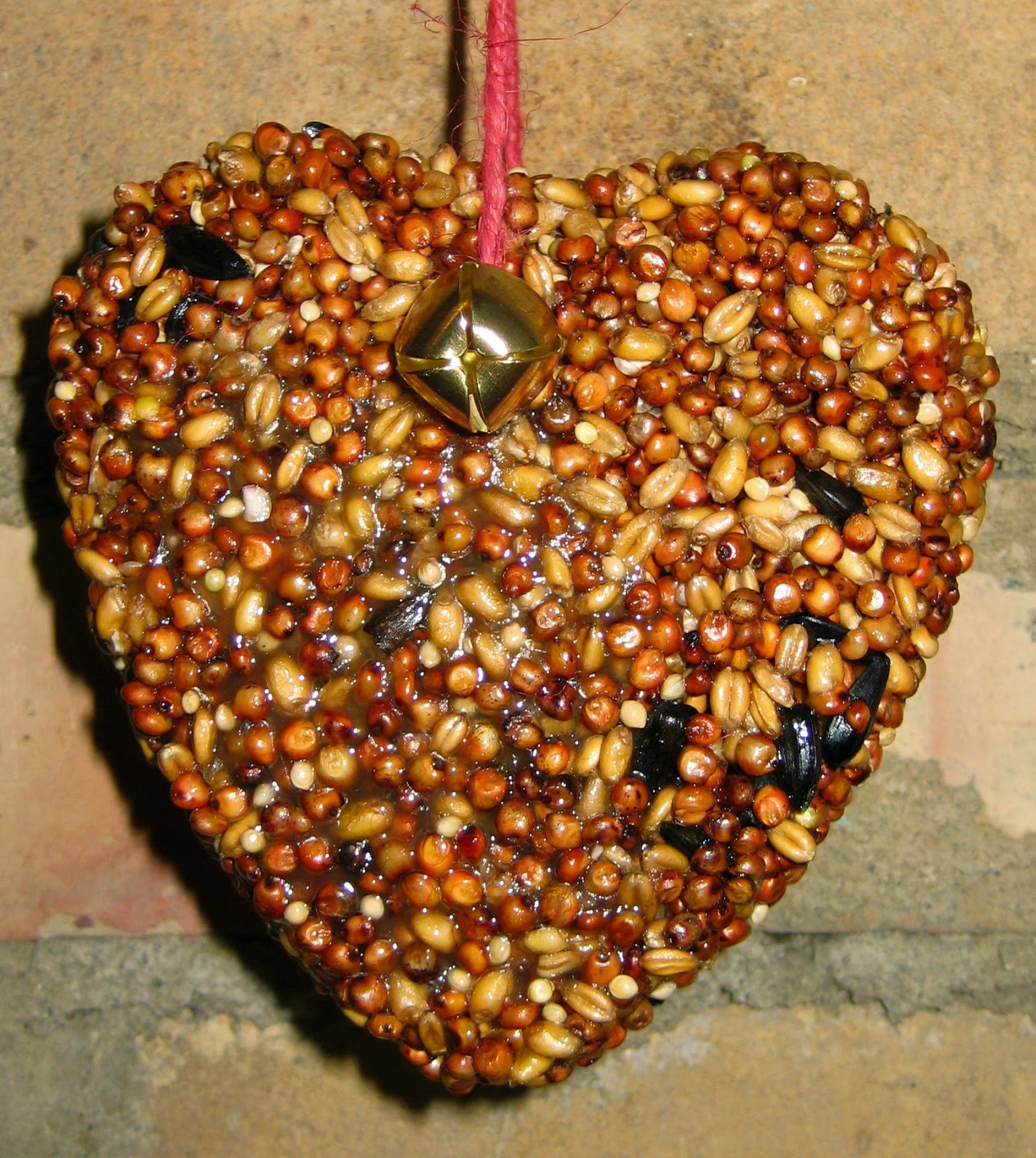
In fact, I believe that a gift for the birds in your area might be in order for Valentine's Day this year. Molded birdseed might fit the bill and make a great gift for the human recipients of your affection as well. "Let love take flight!" I say.


Begin with a small cake mold no more than three inches in diameter. If the mold is too large, it gets too heavy and won't hold up well when hung. Dissolve two 1/4-ounce packets of unflavored gelatin in 3/4 cup boiling water. Add four cups of good quality birdseed (mixed with dried fruit, if you like), and stir until well coated. Press the seed tightly into the mold, inserting a drinking straw all the way through the birdseed one inch from the top. 


Place your mold with straw in the refrigerator overnight before gently releasing from the mold. Let the birdseed mold air dry for several hours before trimming the straw and inserting jute string through it for the hanger. You can decorate the birdseed mold with bells or buttons or greenery, for example, and gift wrap it for giving. Or, simply hang the birdseed mold outside and wait for customers to come and dine -- they will appreciate the feast!


Please note: You may add cayenne pepper or chili oil to the birdseed and gelatin mixture as a squirrel deterrent. However, be sure to take care to not irritate skin or eyes, if you do so. 


***For a real treat, hear Auden read "The More Loving One" here.

Tuesday, January 13, 2015

Feeder

I am down to one feeder in our back yard. It is large, "squirrel-proof" and filled with nyjer and black sunflower seeds which interests the songbirds while keeping the house sparrows at bay.
I recently watched Margaret Roach of A Way to Garden on Growing a Greener World. The podcast focused on gardening for birds.
Margaret really got me thinking differently about how I landscape and plant on my little acre at NOLD, keeping the health and needs of wildlife in mind.
The fundamental concept is simple: Why place feeders out when your landscape may feed and care for birds all year round, if you plan appropriately and choose foliage carefully?
In large part, this philosophy rests on learning from nature and returning our landscape to a more balanced natural setting.
I will proceed from this starting point when I plan for the garden in the spring -- small steps in the right direction with the long term in mind.
On my walk last week as we saw a brief winter thaw, I could see food for wildlife all around me along the roadside.
The neighborhood is littered with plants and bushes that provide berries and seeds for the taking throughout the winter.
Some were planted purposely; some were not. Some were cultivated plantings; others were "weeds" spread naturally -- one must contain their chokehold, but they provide food for wildlife nonetheless.
Over the next few months, I will be contemplating steps I can take to fill nature's feeder more than the actual bird feeder I set up under the cedar grove in the back yard. I have much to learn, but I can't wait to get started.